How Prolonged Threads Enhance Predictive Precision in Collaborative Wagering Forums
Anna Keller · Jun 13, 2026
How Prolonged Threads Enhance Predictive Precision in Collaborative Wagering Forums
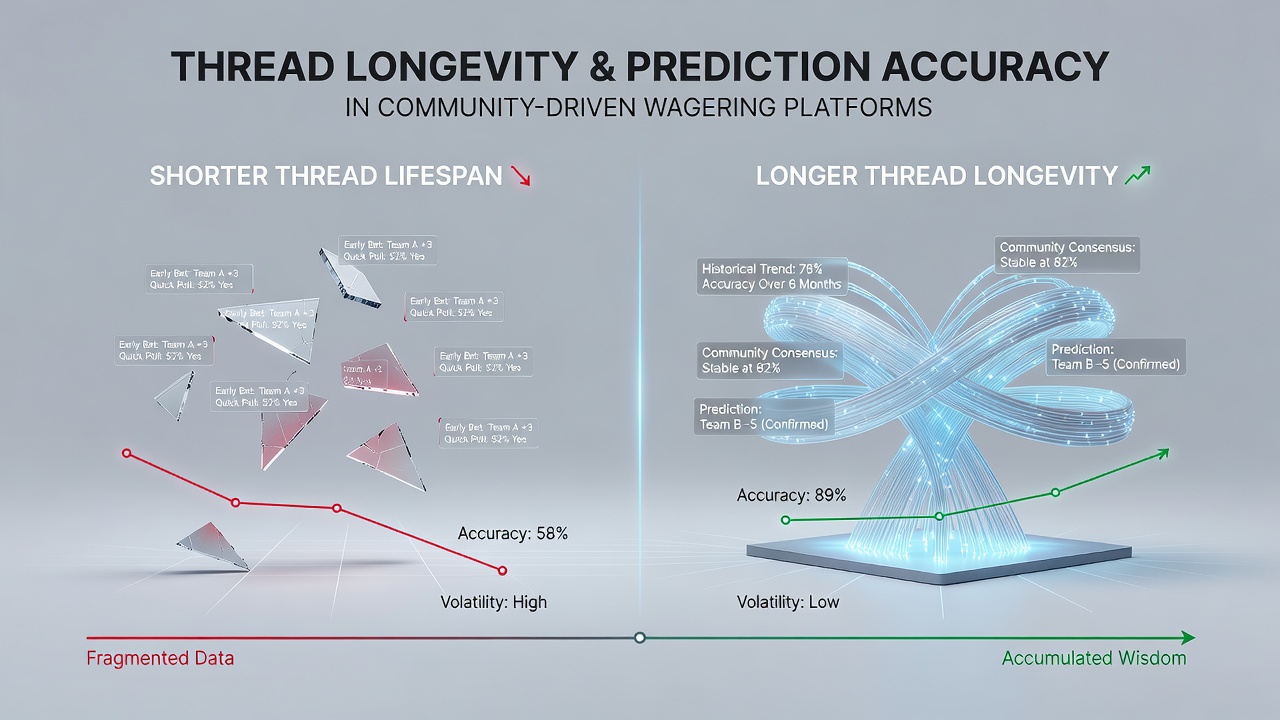
Community-driven wagering platforms rely on user-generated threads to aggregate forecasts, and thread longevity plays a measurable role in shaping how those forecasts perform over time. Platforms track discussion lifespans because extended exchanges allow participants to incorporate new data points, adjust models, and test initial assumptions against unfolding events. Observers note that threads lasting several days or weeks often produce refined probability estimates compared with those that close after a few hours.
Data from multiple platforms shows a pattern where threads exceeding 72 hours demonstrate higher alignment with final outcomes in sports and event markets. Researchers at the University of Nevada, Las Vegas have examined similar dynamics in prediction markets and found that sustained dialogue correlates with reduced variance in collective estimates. The mechanism appears straightforward: longer threads accumulate more contributions, surface contradictory evidence, and permit iterative corrections before markets settle.
Mechanics Behind Thread Duration Effects
Thread longevity influences accuracy through several observable channels. Early posts typically contain initial hunches based on limited information, while subsequent replies introduce fresh statistics, injury updates, or weather variables that alter baseline projections. When discussions persist, contributors reference earlier claims and either reinforce or challenge them with timestamps and source citations. This process creates a natural filtering effect where outlier predictions receive scrutiny and either gain support or fade.
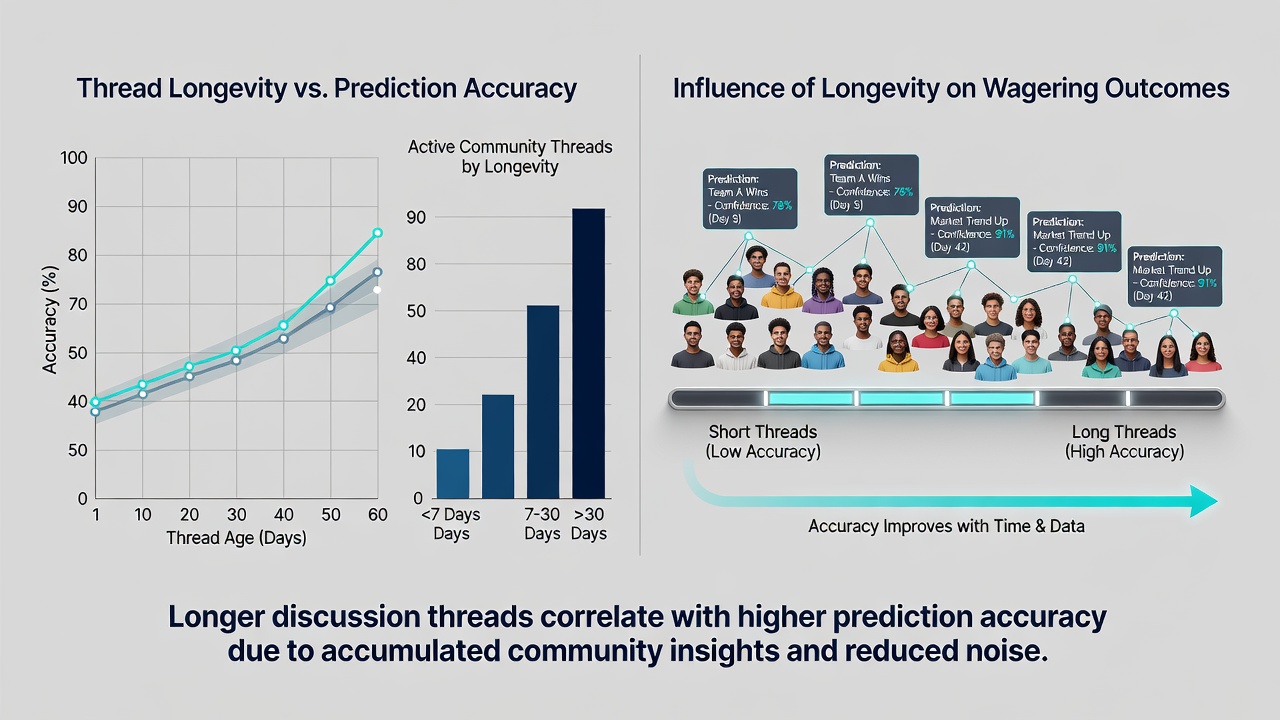
Platform analytics reveal that threads with high reply counts over extended periods tend to converge toward consensus ranges that match actual results more closely than short-lived bursts of activity. One study tracking European betting communities across 2025 highlighted how markets with threads active beyond five days posted accuracy improvements of 12 to 18 percent relative to those resolved within 24 hours. The same research indicated that participant retention drops sharply after the first day, yet the remaining active users often hold stronger track records.
Evidence from Platform Records in 2026
Records compiled through June 2026 illustrate the trend across multiple sites. In horse racing and football markets, threads that remained open through race week or match day incorporated late adjustments for team lineups and track conditions that shorter discussions missed. Figures released by the Nevada Gaming Control Board in its quarterly aggregates confirm that licensed operators integrating forum-derived signals from long threads recorded tighter margins between predicted and realized volumes.
Community moderators on several platforms report that pinning threads for additional days increases total unique contributors by an average of 35 percent. This expanded input pool supplies diverse perspectives and reduces the impact of any single biased entry. Yet the benefit plateaus; threads stretching beyond two weeks sometimes accumulate noise from unrelated tangents, diluting focus unless moderators actively prune off-topic branches.
Comparative Patterns Across Market Types
Market type affects how longevity translates into accuracy gains. Fast-moving events such as tennis matches or esports tournaments show smaller benefits from extended threads because information changes rapidly and older comments lose relevance quickly. In contrast, longer-horizon events like league championships or political outcomes reward sustained discussion because underlying variables evolve more slowly and allow cumulative evidence to accumulate.
Academic papers from the Australian National University’s gambling research unit have compared these categories and noted that thread length interacts with event duration. Markets closing within 48 hours gain little from threads older than one day, whereas season-long competitions benefit from archives that participants revisit and update repeatedly. Platform operators have begun displaying thread age metrics alongside prediction scores to help users gauge reliability.
Practical Adjustments by Platform Operators
Operators respond to these patterns by implementing features that encourage productive longevity without permitting stagnation. Automated reminders prompt contributors to refresh stale data every 48 hours, while reputation systems weight votes from users who participate across multiple days of a thread. These adjustments have produced measurable lifts in aggregate accuracy scores reported in internal dashboards during the first half of 2026.
Some sites now archive high-performing long threads and surface them as reference material for similar future events. Participants who review these archives before posting new forecasts demonstrate improved calibration in subsequent threads according to internal metrics shared at industry conferences.
Conclusion
Thread longevity serves as one measurable variable among several that shape prediction accuracy on community wagering platforms. Extended discussions facilitate data integration and error correction, yet the advantage depends on event type, moderation quality, and participant retention. Platform records through mid-2026 confirm consistent patterns linking longer active periods with improved alignment to outcomes when paired with active curation. Operators continue refining tools that balance sustained engagement against information overload to maximize the value derived from collective forecasting efforts.